
OpenSemantics develops open standards, frameworks, and specifications for building AI systems that organizations, regulators, and the people they serve can genuinely trust.
No trust, no right to deploy AI.
Trust is the foundation of every system — whether built from people, traditional code, or AI. A user must trust that a system delivers an appropriate result for its purpose. Not perfect. Appropriate.
We extend trust based on its design and how it operates — within reasonable expectations of responsible design, reliability, quality, and oversight that can identify, prevent, and mitigate issues when they arise.
Agentic AI changes the scale and complexity of what that trust requires. When an AI system acts autonomously across tools, services, and data — making decisions and executing workflows without human intervention at every step — the expectations of responsible design, reliability, and oversight don't diminish. They compound.
Without those assurances, there can be no trust. And without trust, there is no right to deploy.
of agentic AI projects will be canceled by 2027 due to inadequate risk controls
of enterprises have full security approval for all AI agents currently in production
of organizations have identity governance in place for AI agents
of AI-related security breaches lacked proper access controls
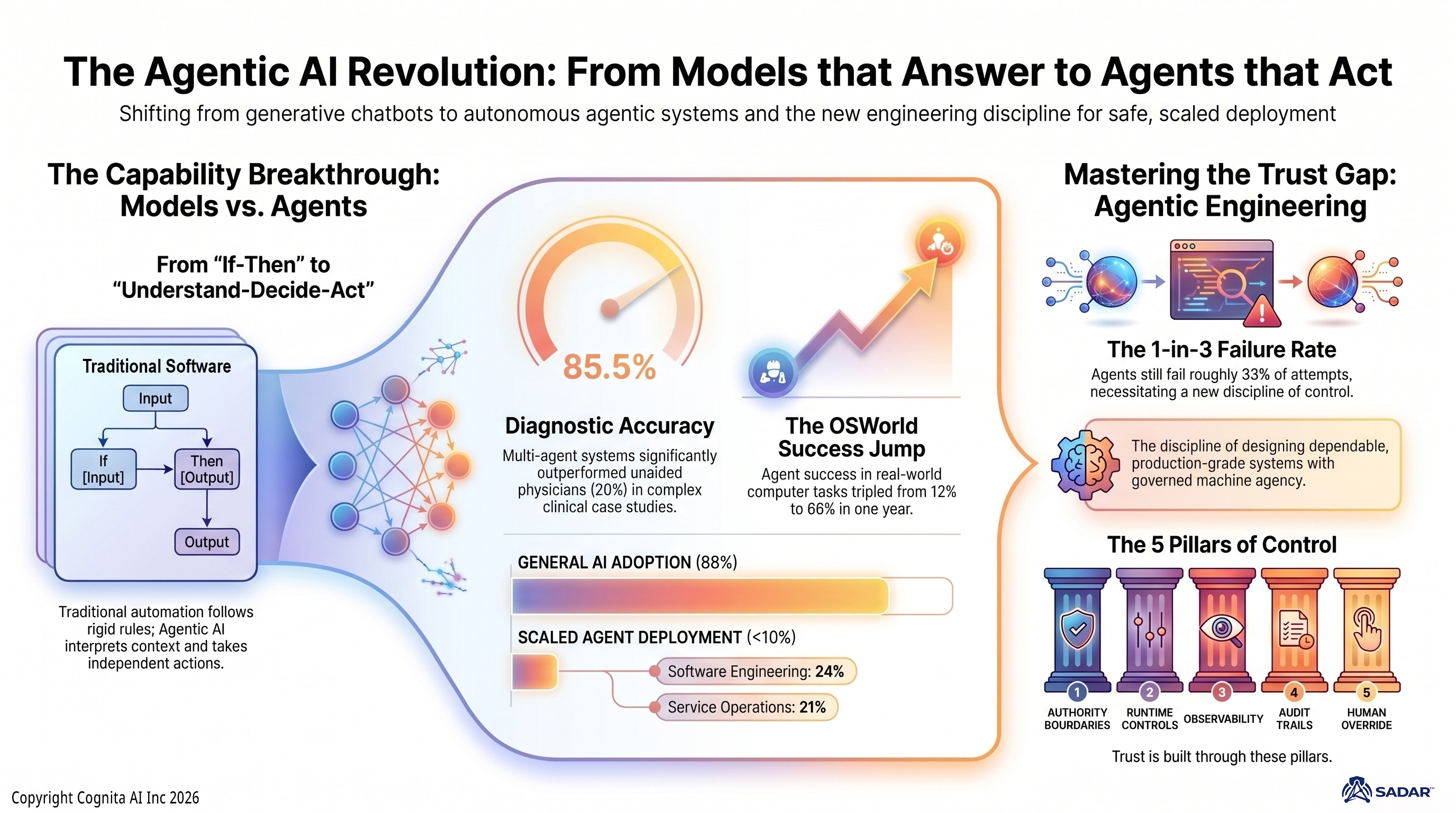
AI answers through probabilistic matching and predictions of what the answer should be. Agents further disrupt the status quo by observing conditions, determining a plan, discovering other agents, tools, and resources to utilize, executing the plan, and assessing its own results. We don't know what actions it will take beforehand. Because of the probilistic nature, we may not always be able to repeat the results.
Traditional systems are built with static rules. They are used by the same people, for the same purpose, and produce repeatable results - every time. Controls rely on this predictibility. It is how we test, assign access/controls, and audit. AI is different. It isn't programmed, it is trained.
Pre-defined, static controls fail when use isn't determined until runtime.
True AI trustworthiness demands more than compliance. Explore the foundational disciplines—governance, security, and continuous monitoring—that close the trust gap and enable responsible, auditable AI at scale.
The primary barrier to realizing the full value of AI is not capability—it is trust. Enterprise control frameworks were built for a deterministic world, where systems behave predictably, users operate within defined roles, and processes are explicitly designed, tested, and audited. These assumptions no longer hold.
As organizations adopt AI—particularly agentic systems that can plan, act, and adapt independently—they introduce probabilistic behavior into environments that demand consistency, accountability, and explainability. The result is a fundamental breakdown in how we establish control.
We can no longer reliably determine:
Without these foundations, traditional approaches to access control, policy enforcement, risk management, and auditability become insufficient. Bridging this gap—establishing a model for Trustworthy AI that restores visibility, control, and accountability in probabilistic systems—is now the critical challenge facing enterprises seeking to operationalize AI at scale.
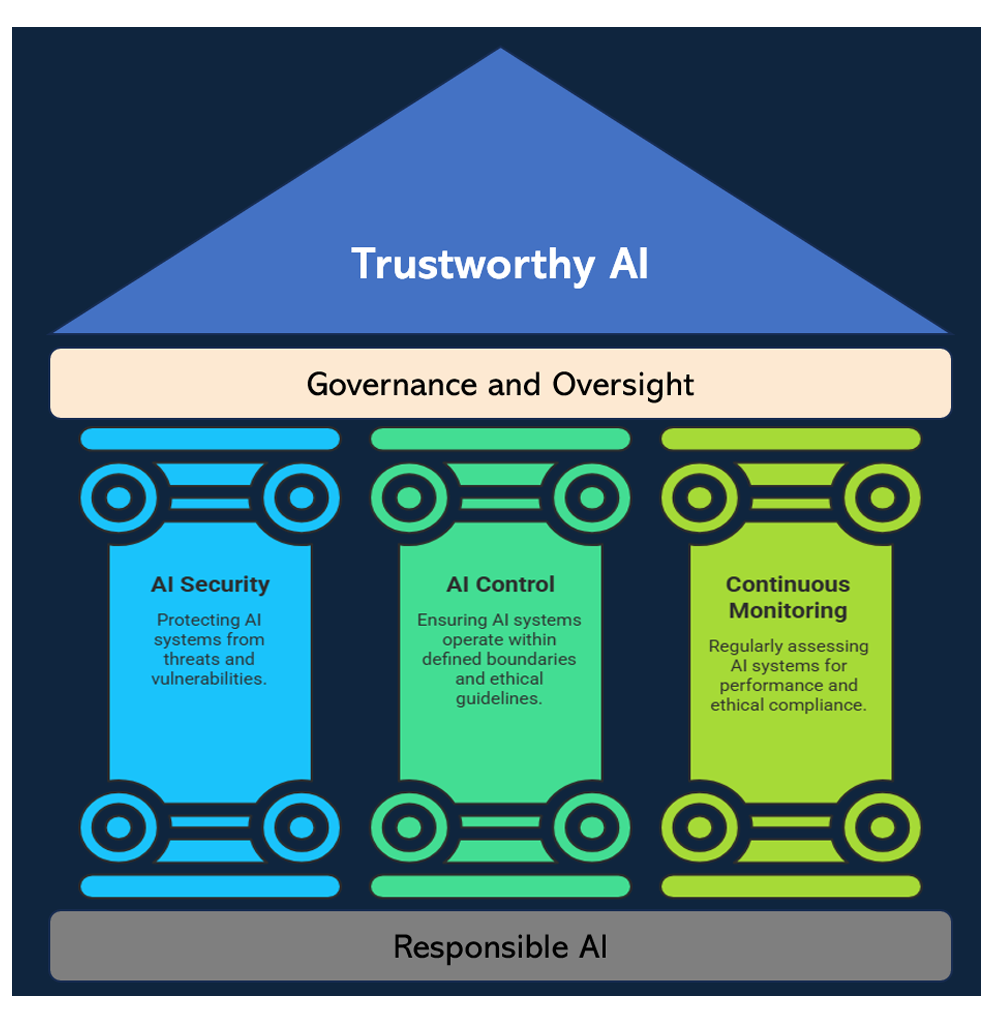


Trustworthy AI is not a feature you add — it is the outcome of getting everything else right. Responsible use, security, control, monitoring, and governance are not independent checkboxes. They are interdependent layers: a gap in any one of them undermines the trust of every stakeholder who depends on the system.The standard for AI should be the same standard we already apply to the humans executing the same processes. We record calls. We sample outcomes. We define escalation triggers. We audit. We do this not because our people are untrustworthy, but because accountability requires it. AI is no different — and the organizations that govern it that way will be the ones that can grant it meaningful autonomy.
Trustworthy AI is not the absence of risk. It is the presence of accountability.
Responsible AI defines the boundaries within which AI systems are permitted to operate — before deployment, not after an incident.It means assessing the likelihood and impact of undesired outcomes, and making explicit decisions about what the organization will and will not accept.
It means defining what a correct result looks like, what deviation triggers intervention, and how affected parties — users, customers, employees — are informed of AI involvement in decisions that affect them.
Responsible AI is the governance layer that answers: should we deploy this, under what constraints, and to whom are we accountable if it goes wrong?
AI systems introduce attack surfaces that traditional security frameworks were not designed to address.
Beyond the standard requirements for confidentiality, integrity, and availability, AI systems are vulnerable to threats specific to their architecture: training data poisoning, prompt injection, model inversion, context manipulation, and supply chain compromise of model components. An agent that can be instructed by malicious content it observes is a fundamentally different risk profile than a deterministic application.
AI Security extends proven security practices into the AI layer — ensuring that what executes is what was reviewed, that inputs cannot redirect behavior, and that the components operating in the system are what they claim to be.
Control means that AI systems do what they are authorized to do — and nothing else.
For AI-enabled systems, this means enforcing that outputs fall within defined acceptable boundaries and that deviations are detected and addressed. For agentic systems, the challenge is more fundamental: an agent that discovers its own tools, invokes other agents, and operates across organizational boundaries requires positive control over every resource it can access — what it can discover, what it can invoke, under what identity, and in what context.
Without AI Control, scope of authority becomes theoretical. The agent operates with whatever it can reach, not whatever it should have.
AI systems do not remain stable. Models drift. Data distributions shift. Results that were acceptable at deployment gradually move outside defined boundaries — often without any change to the system itself.
Continuous monitoring is the ongoing function that detects these changes before they cause harm: results deviating from accepted ranges, bias emerging in outputs, resource utilization patterns changing, and agents accessing capabilities outside expected norms.
Critically, monitoring AI for appropriate results is a business function, not a technology function. The business owns the process the AI is executing — and business owners are the only ones positioned to recognize when outcomes are drifting from intent.
Governance is what makes all other layers durable.
The business environment changes. Risk decisions made at deployment age. Control outputs require review. New threats emerge. Best practices evolve. Without a governance function with actual authority — not merely advisory — the other layers degrade over time as the world around them changes while the controls do not.
An AI governance function modeled on the Institutional Review Board: prospective review before deployment, defined criteria applied consistently, a decision record for each material deployment, and the authority to halt or modify what does not meet the standard. Governance is not a constraint on AI adoption. It is the precondition for expanding it.
The Highest-value AI Use Cases Are Also the Most Ungoverned
Can your Agentic AI systems satisfy regulators, auditors, and customers today?
![[digital project] image of a showcased project (for a ai robotics and automation)](https://cdn.prod.website-files.com/69d6d41ffe382fa7b092cd80/69d7b978d1d99b1ae07f6f9e_3fe44914-a123-42d5-a96f-ea9b44a565b5.avif)
Access in-depth frameworks, expert analysis, and the latest developments for building AI systems that meet rigorous standards for reliability, oversight, and organizational control.
Expert insights on trustworthy AI standards
The framework defines enforceable governance for AI, establishing traceability, oversight, and compliance. It addresses the unique challenges of agentic AI, offering actionable guidance for responsible, auditable deployment in complex environments.
These standards serve enterprises, regulators, and solution providers aiming to operationalize trustworthy AI. Designed for scalability, they support both early adoption and highly regulated, complex organizational needs.
Compliance is evidenced through documented controls, audit trails, and ongoing monitoring. The framework enables transparent governance, risk management, and regulatory alignment, supporting reproducible and auditable AI operations.
Yes. The standards are built for interoperability, enabling seamless integration with existing infrastructure, security protocols, and compliance workflows—minimizing disruption and accelerating adoption.
Extensive documentation, community forums, and expert guidance are available. Organizations can access best practices, reference architectures, and join working groups to address specific implementation challenges.
The framework extends beyond technical security, encompassing governance, control, and continuous monitoring. It ensures AI systems are reliable, auditable, and aligned with organizational values—not just secure.
Looking for deeper implementation advice?
Reach out to discuss your organization’s AI governance needs, implementation challenges, or compliance questions. Our team will provide detailed, actionable guidance on building accountable, transparent, and reliable AI systems.





![[headshot] image of a customer (for a financial advisor)](https://cdn.prod.website-files.com/69d6d41ffe382fa7b092cd80/69d7b978d1d99b1ae07f6f40_2aac7b4f-44b4-4a31-b855-b32b28b29e05.avif)

![[headshot] image of customer](https://cdn.prod.website-files.com/69d6d41ffe382fa7b092cd80/69d7b978d1d99b1ae07f6ef5_2732fc28-ff89-448e-a02c-1cd7ea7ad4b5.avif)

![[headshot] image of customer (for a plumbing service).](https://cdn.prod.website-files.com/69d6d41ffe382fa7b092cd80/69d7b978d1d99b1ae07f6f08_fe1eac71-9507-4eeb-8721-9806bc91ef95.avif)

![[headshot] image of customer (for a university)](https://cdn.prod.website-files.com/69d6d41ffe382fa7b092cd80/69d7b978d1d99b1ae07f6f0e_ef854099-d0c9-4300-82cc-8d626549eddf.avif)
![image of an expert consultant [headshot]](https://cdn.prod.website-files.com/69d6d41ffe382fa7b092cd80/69d7b978d1d99b1ae07f6f92_3c532716-180e-4647-af78-adbe0f186d7c.avif)

![[headshot]](https://cdn.prod.website-files.com/69d6d41ffe382fa7b092cd80/69d7b978d1d99b1ae07f6f2f_1062c00a-f28e-427a-bcc0-7bbd46a9110f.avif)

![[headshot] image of customer (for a plumbing service).](https://cdn.prod.website-files.com/69d6d41ffe382fa7b092cd80/69d7b978d1d99b1ae07f6f81_b653f934-5b07-4e3c-b414-476124dd56eb.avif)

![image of customer [headshot]](https://cdn.prod.website-files.com/69d6d41ffe382fa7b092cd80/69d7b978d1d99b1ae07f6ef2_d83da219-9a3a-495b-88d7-08d65423ba6e.avif)

![[headshot] image of a customer (for a japanese restaurant)](https://cdn.prod.website-files.com/69d6d41ffe382fa7b092cd80/69d7b978d1d99b1ae07f6f48_8d093b14-c984-4097-810d-2f2bf4801a92.avif)

![[headshot] image of customer giving a testimonial (for a ai biotech company)](https://cdn.prod.website-files.com/69d6d41ffe382fa7b092cd80/69d7b978d1d99b1ae07f6f36_55429bb4-2cb2-4f40-acab-4d61c53933fd.avif)

![[headshot] image of customer giving a testimonial (for a ai biotech company)](https://cdn.prod.website-files.com/69d6d41ffe382fa7b092cd80/69d7b978d1d99b1ae07f6f4b_101bb621-20ad-4401-9260-da37e0ae7970.avif)

![[headshot] image of customer for entertainment company](https://cdn.prod.website-files.com/69d6d41ffe382fa7b092cd80/69d7b978d1d99b1ae07f6f5c_f5b1ef1c-c1ff-43a5-9d77-41ebfdc6af17.avif)

![[headshot] image of customer (for a trucking company)](https://cdn.prod.website-files.com/69d6d41ffe382fa7b092cd80/69d7b978d1d99b1ae07f6f4e_d918d59e-7cd3-4217-aa84-a7c43eb3f6d0.avif)
![[interface] image of a tablet with software interface (for an ai developer tools)](https://cdn.prod.website-files.com/69d6d41ffe382fa7b092cd80/69d7b978d1d99b1ae07f6f76_ba5c4ce2-93cb-48bc-b1c5-29099ed40956.avif)
![[headshot] image of a customer (for a mobility and transportation)](https://cdn.prod.website-files.com/69d6d41ffe382fa7b092cd80/69d7b978d1d99b1ae07f6f5f_4a35de9e-2fc9-4e08-b724-4f0d1c91bd8a.avif)

![[headshot] image of customer](https://cdn.prod.website-files.com/69d6d41ffe382fa7b092cd80/69d7b978d1d99b1ae07f6f7e_530148ab-c502-4f29-b3eb-a78e1d5f1665.avif)

![[headshot] image of customer (for a social media and communication)](https://cdn.prod.website-files.com/69d6d41ffe382fa7b092cd80/69d7b978d1d99b1ae07f6f43_78204477-710d-47fa-88c3-b16b6d8acd04.avif)